Posts

Showing posts with the label Food Microbiology

Bovine Spongiform Encephalopathy (BSE)
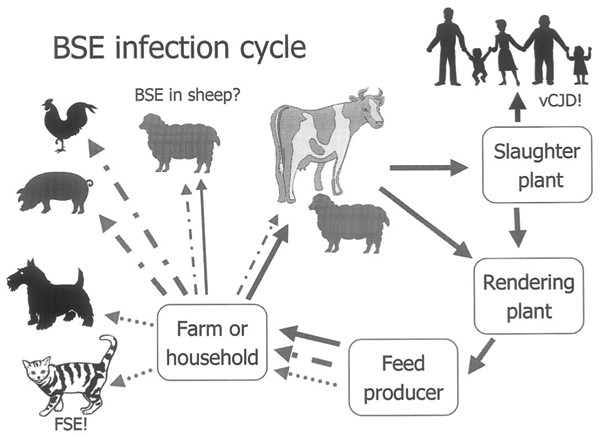
Image
  Bovine Spongiform Encephalopathy (BSE) Spongiform encephalopathies (SEs) are degenerative disorders of the brain that occur in a number of species. They are recognized by the clinical appearance of the affected animal and the characteristic histological changes they produce in the brain.  One of the common Spongiform encephalopathy is Bovine Spongiform Encephalopathy (BSE),which mainly affect cattle. Bovine Spongiform Encephalopathy (BSE), widely referred to as “mad cow disease,” is a progressive and fatal neurologic disease of cattle. It is caused by  an unconventional transmissible agent, an abnormal prion protein . "Bovine" means that the disease affects cows, "spongiform" refers to the way the brain from a sick cow looks spongy under a microscope, and "encephalopathy" indicates that it is a disease of the brain. The infection spreads to cattle by the practice of feeding them abattoir waste and offal which may have contained scrapie infected meat. ...

Pulsed Electric Fields infood preservation

  Pulsed Electric Fields   Pulsed electric fields PEF is a non-thermal method of food preservation that uses short pulses of electricity for microbial inactivation and causes minimal damaging effect on food qualities. PEF technology aims to offer consumers high-quality foods. High Intensity Pulsed Electric Field (PEF) Processing involves the application of pulses of high voltage (typically 20-80 kV/cm) to foods placed between 2 electrodes . PEF may be applied in the form of exponentially decaying, square wave, bipolar, or oscillatory pulses and at ambient, sub-ambient, or slightly above ambient temperature for less than 1s. Energy loss due to heating of foods is minimized, reducing the detrimental changes of the sensory and physical properties of foods. PEF treatments showed effects on the microbial inactivation in milk, milk products, egg products, juice and other liquid foods Some important aspects in pulsed electric field technology are the generation of high e...

A short note on botulism

Cl.botulinum Ø   Causes   botulism( Sausage poisoning/fatty poisoning) Ø   A paralytic disease mainly through food poisoning MORPHOLOGY ·         Gm+   ve rod shape bacteria ·         Non capsulated ·         Motile   by peritrichous flagella ·         Produce spores CULTURAL CHARACTERS §   Strict anaerobe §   Optimum temperature   for growth is 35 o C §   Shows good growth in ordinary media §   Sporulate better in alkaline glucose   gelatin media at   20-25 C . RESISTANCE ·         Spores are   heat     resistant    and      radiation   resistant    .  CLASSIFICATION ·         Cl.botulinum are classified into 8 types on ...